

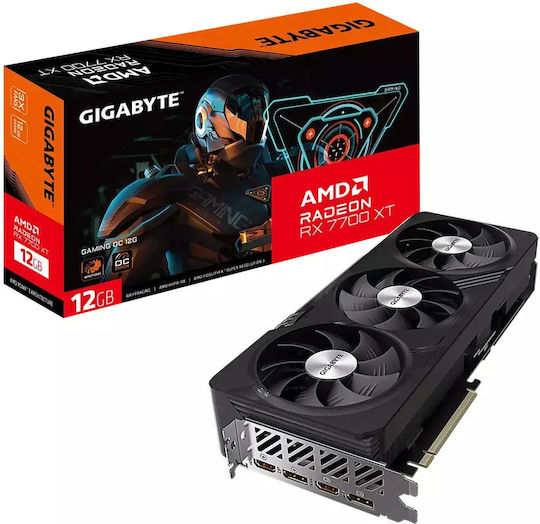
RX 7700 XT looks quite good compared to the previous-gen RX 6700 XT. You get substantially more compute, which is the key selling point. Theoretically, the RX 7700 XT offers 167% more number-crunching prowess than the 6700 XT. Even though we’ve pointed out in other RDNA 3 reviews that performance doesn’t match that lofty figure, it’s a good step up from the 6700 XT.
The problem is that i’s also a big step up in price relative to the existing cards, where online pricing has dropped to $329 for the RX 6700 XT and $349 for the RX 6750 XT, and even the RX 6800 costs less than the 7700 XT at a current price of $429. The RX 6800 also has more memory and a wider interface, and as we’ll see later, it provides stiff competition for the newcomer.
The other problem is the RX 7800 XT that uses the full Navi 32 implementation. On paper, the RX 7800 XT offers 6% more GPU compute, but 44% more memory bandwidth and 33% more memory capacity. And you get all that for an 11% increase in price. Spoiler alert: Generally, the RX 7800 XT is up to 20% faster. Short of a price cut, it’s the better buy. Maybe that’s why AMD is leaving all the RX 7700 XT production to its AIB (add-in board) partners.https://www.pcworld.com/article/2055699/amd-radeon-rx-7700-xt-and-7800-xt-review.html?utm_source