


Updated on March 31, 2026
Emotional Regulation in Preschoolers
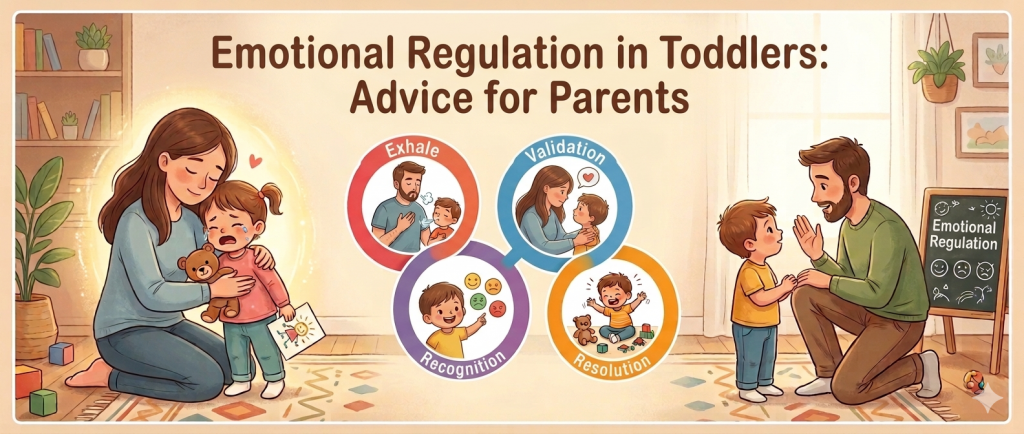
What is Emotional Regulation?
Emotional regulation is a child's ability to recognise what they feel, to manage the intensity of the emotion, and to choose how to respond.
A child with a good level of emotional self-regulation may sometimes feel things intensely, but knows that the feeling will pass and that they can cope with it.
Why is it so important at ages 4–6?
- The toddler's brain is still developing, particularly the prefrontal cortex (impulse control).
- Emotional regulation is a skill that develops through repeated experiences with caregivers.
- Children with better emotional regulation tend to do better socially, academically, and emotionally.
Helpful Strategies for Parents
- Create routines: Predictability creates a sense of safety. Children who know what comes next regulate more easily.
- Model it: Talk aloud about your own emotions: "I'm feeling angry right now, so I'm going to take a deep breath."
- Regulate yourself first: Avoid an immediate, impulsive reaction and give yourself a moment if you need it to stay calm. Your child's nervous system mirrors yours — your calm can be regulating in itself.
When your child "explodes", follow these steps in order:
⚠️ Important: The 4 steps work best in this order. Do not go straight to "Set the Limit" (step 4) before the child has calmed down, as their brain may not yet be able to process rules while still in a state of high tension. The pace of moving from one step to the next depends on the child — follow their rhythm.
What to Avoid
Reactions that make things worse:
- ❌ "Stop crying right now!" — ignores the emotion and increases tension.
- ❌ "It's nothing, don't worry" — in that moment the child feels something real; they gradually learn not to share it because they won't be understood.
- ❌ Punishment — the child isn't usually capable of rational processing in that state, so it won't teach a skill, it will add stress instead.
- ❌ Giving in to the demand to stop the meltdown — reinforces the outburst as a way of communicating.
How Do I Recognise It?
The following signs may indicate difficulty with emotional regulation:
When to Seek Professional Help
Seek advice from a specialist if:
- Outbursts occur many times a day over an extended period.
- The child frequently hurts themselves or others.
- Daily functioning (sleep, eating, play) is significantly affected.
- The child cannot calm down with adult support, even after considerable time.
- There is a significant change in behaviour following a particular event.
Remember:
Emotional regulation does not develop overnight — it is a long-term process.
The child is not being 'manipulative' — they are doing the best they can with the tools they have right now.
The most powerful intervention is the relationship: a calm, consistent adult who does not withdraw.
An Activity for Today
🎨 Make a 'Feelings Thermometer' Together
On a piece of paper, draw a ladder with 5 rungs. Give each rung a colour and an emotion (1 = calm / green, 5 = very angry / red). Each day, your child can show where they are. They will soon start doing it on their own.
🌬️ Dragon Breathing
Breathe in through the nose for a count of 4, hold for 2, breathe out through the mouth like a dragon breathing fire for a count of 6. Repeat 3 times. It's fun and genuinely effective for regulation.
📅 For any questions, contact the school psychologist
| 42ο Νηπιαγωγείο | 120ο Νηπιαγωγείο | 124ο Νηπιαγωγείο | 157ο Νηπιαγωγείο |