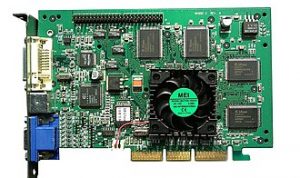
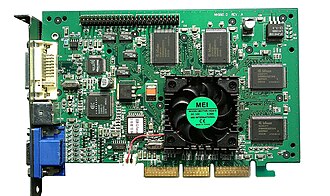
GeForce 256 was marketed as "the world's first 'GPU', or Graphics Processing Unit", a term Nvidia defined at the time as "a single-chip processor with integrated transform, lighting, triangle setup/clipping, and rendering engines that is capable of processing a minimum of 10 million polygons per second".[2][3]
The "256" in its name stems from the "256-bit QuadPipe Rendering Engine", a term describing the four 64-bit pixel pipelines of the NV10 chip. In single-textured games NV10 could put out 4 pixels per cycle, while a two-textured scenario would limit this to 2 multitextured pixels per cycle, as the chip still had only one TMU per pipeline, just as TNT2.[4] In terms of rendering features, GeForce 256 also added support for cube environment mapping[4] and dot-product (Dot3) bump mapping.[5]
The integration of the transform and lighting hardware into the GPU itself set the GeForce 256 apart from older 3D accelerators that relied on the CPU to perform these calculations (also known as software transform and lighting). This reduction of 3D graphics solution complexity brought the cost of such hardware to a new low and made it accessible to cheap consumer graphics cards instead of being limited to the previous expensive professionally oriented niche designed for computer-aided design (CAD). NV10's T&L engine also allowed Nvidia to enter the CAD market with dedicated cards for the first time, with a product called Quadro. The Quadro line uses the same silicon chips as the GeForce cards, but has different driver support and certifications tailored to the unique requirements of CAD applications.[6]
The chip was manufactured by TSMC using its 220 nm CMOS process.[7]
There was only one GeForce 256 release, as succeeding GeForce products would have varying chip speeds. However there were two memory configurations, with the SDR version released in October 1999 and the DDR version released in mid-December 1999 – each with a different type of SDRAM memory. The SDR version uses SDR SDRAM memory from Samsung Electronics,[8][9] while the later DDR version uses DDR SDRAM memory from Hyundai Electronics (now SK Hynix).[10][11]