
NV1
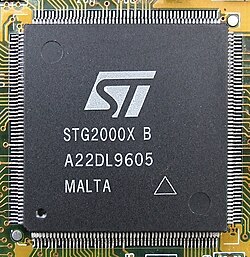
The NV1 was Nvidia's first graphics accelerator, introduced in May 1995 and released later that year as a multimedia PCI card.[2] Manufactured by SGS-Thomson Microelectronics, sometimes under the model name STG2000, the chip was sold in retail by Diamond as the Diamond Edge 3D card. The NV1 stood out for its use of quadratic texture mapping, a departure from the triangular primitives favored by competitors. The use of quadratics made it possible to port games from the Sega Saturn, however, after the NV1 was introduced, Microsoft announced that DirectX would exclusively support triangle primitives.[3] As a result, the NV1 failed to gain traction in the market.[4]
In addition to its 2D/3D graphics core and Video RAM or FPM DRAM memory, the NV1 card also integrated the functionality of a 32-channel playback-only sound card, and had a joystick port, along with ports for two Sega Saturn controllers. As such, it was marketed as a "multimedia card" that was a replacement for both a graphics card and a Sound Blaster-compatible audio card in IBM PC compatible systems. However, this made it more expensive, and with many computer owners owning a sound card, the all-in-one design further hurt its market appeal.
The NV2 was a follow-up chip developed for Sega's Dreamcast, but was ultimately abandoned. Nvidia shifted focus with its next product, the RIVA 128, which adopted triangle primitives and dropped the audio functionality. This alignment with Direct3D and a more streamlined design made the RIVA 128 a success.
RIVA 128
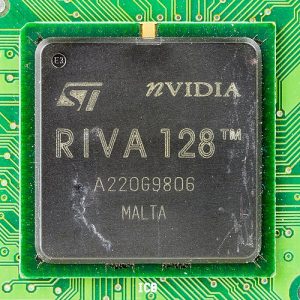
The RIVA 128, or "NV3", was a consumer graphics processing unit created in 1997 by Nvidia. It was the first nVidia product to integrate 3D acceleration in addition to traditional 2D and video acceleration. Its name is an acronym for Real-time Interactive Video and Animation accelerator.[2]
The RIVA 128 followed Nvidia's less successful "NV1" accelerator and was the first product to gain Nvidia widespread recognition. It was also a major change in Nvidia's technological direction.
Riva TNT
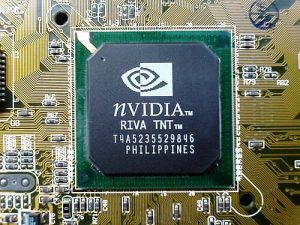
The RIVA TNT, codenamed NV4, is a 2D, video, and 3D graphics accelerator chip for PCs that was developed by Nvidia, announced in March 1998 and released at the end of August 1998.[1] It cemented Nvidia's reputation as a worthy rival within the developing consumer 3D graphics adapter industry. It succeeded the RIVA 128.
RIVA is an acronym for Real-time Interactive Video and Animation accelerator.[2] The "TNT" suffix refers to the chip's ability to work on two texels at once (Twin Texel).[3]
The first graphics card that was based on the RIVA TNT chip was the Velocity 4400, released by STB Systems on August 31, 1998.
Riva TNT2
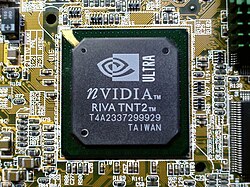
The RIVA TNT2 is a graphics processing unit manufactured by Nvidia starting in early 1999. The chip is codenamed "NV5" because it is the 5th graphics chip design by Nvidia, succeeding the RIVA TNT (NV4). RIVA is an acronym for Real-time Interactive Video and Animation accelerator.[1] The "TNT" suffix refers to the chip's ability to work on two texels at once (TwiN Texel).[2] Nvidia removed RIVA from the name later[when?] in the chip's lifetime.[2]