
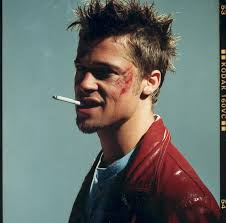
brad pitt and what made him want to star in fight club
Brad Pitt’s role as Tyler Durden in Fight Club is one of his most iconic and defining performances. Tyler Durden is the charismatic, anarchistic, and rebellious character who leads the underground fight club that the protagonist (played by Edward Norton) becomes involved with. Tyler is bold, confident, and unapologetically anti-establishment, offering a radical contrast to the protagonist’s initial numb, consumer-driven existence.
Pitt’s portrayal of Tyler helped to elevate the film to cult classic status. His performance exudes a magnetic, larger-than-life energy that perfectly matches the character’s philosophy of rejecting societal norms and embracing chaos. Tyler represents freedom, strength, and the rejection of materialism, making him a complex and controversial figure in the film.
A key aspect of the character is the relationship between Tyler and Norton’s character. Initially, Tyler seems like a mentor or savior to the narrator, someone who shows him how to break free from the shackles of a monotonous, consumerist life. As the film progresses, the nature of Tyler’s influence on the protagonist grows darker, leading to the film's famous twist, where it is revealed that Tyler is, in fact, a figment of the narrator’s imagination—a representation of his repressed desires and frustrations.
Pitt’s portrayal of Tyler Durden was a sharp contrast to his more traditional leading-man roles at the time, adding layers of depth to the character. Tyler’s charm, wit, and reckless abandon are offset by his eventual descent into dangerous nihilism. Pitt captured the essence of a man who both inspires and manipulates others, all while remaining enigmatic and unpredictable.
The role also helped solidify Pitt’s reputation as an actor who could handle both big-budget action films and more complex, thought-provoking material. After Fight Club, Pitt’s career took on even more diverse projects, from historical epics like Troy (2004) to more introspective roles in films like The Tree of Life (2011) and Moneyball (2011).
Tyler Durden remains one of Brad Pitt’s most memorable characters, not only because of his bravado and sharp wit but also because of how his role in the story challenges the audience's perceptions of masculinity, freedom, and self-destruction. It’s a role that showcases Pitt’s range and his ability to portray complex, morally ambiguous characters with depth.
Brad Pitt’s decision to take on the role of Tyler Durden in Fight Club was influenced by a combination of factors, ranging from the character's complexity to his desire to challenge himself as an actor.
Pitt, at the time, was already one of Hollywood's biggest stars, known for roles in films like Thelma & Louise (1991), Legends of the Fall (1994), and Seven (1995). His career was marked by his good looks and roles as a heartthrob, but he was increasingly drawn to more challenging and unconventional roles. Fight Club represented an opportunity to break away from his typical leading-man image and portray a character who was entirely different: anarchistic, chaotic, and, in many ways, destructive.
The Appeal of Tyler Durden
Tyler Durden is a complex, charismatic figure who challenges societal conventions and pushes the limits of what it means to be free and "alive" in a consumer-driven world. The character's anti-establishment views and rejection of materialism resonated with Pitt, who has always been interested in exploring deeper, darker themes. In interviews, he has spoken about being intrigued by Tyler’s philosophy and the way the character is both a liberator and a manipulator, showing different shades of rebellion and moral ambiguity.
The Script and Director David Fincher
The script for Fight Club, adapted from Chuck Palahniuk's novel by Jim Uhls, was unconventional, edgy, and deeply philosophical. Brad Pitt was particularly drawn to the script’s subversive tone and its exploration of masculinity, self-destruction, and identity. He saw it as an opportunity to work on a film that challenged the audience's expectations and dealt with complex psychological and societal themes.
Pitt was also excited about the opportunity to work with David Fincher, a director who had already proven himself with dark, visually striking films like Seven (1995). Fincher’s approach to storytelling and his unique cinematic style were a big draw for Pitt, who was looking for a director capable of handling the psychological intensity and complexity of the Fight Club material.
Breaking from Hollywood Expectations
By the time Fight Club came around, Pitt was already an A-list actor, but he wanted to take risks and do something that would push him as an artist. In a sense, Tyler Durden offered a chance for him to subvert the traditional roles he was known for. Rather than playing the typical action hero or romantic lead, Pitt got to embrace a darker, more enigmatic figure who wasn’t just physically strong but also mentally and emotionally complex.
He was also intrigued by the character’s philosophy—Tyler's reckless embrace of chaos and his ability to inspire others. This philosophical underpinning of the character gave Pitt something to sink his teeth into, providing layers to the role that went beyond just playing a "bad boy."
Working with Edward Norton
The dynamic between Pitt’s Tyler Durden and Edward Norton’s unnamed protagonist (the Narrator) was another element that attracted Pitt to the project. The relationship between the two characters, one that evolves from friendship to something far more dangerous, became central to the film’s exploration of identity and self-destruction. Pitt has often spoken about the chemistry he had with Norton, which helped elevate the film’s dramatic tension.
The Legacy of Fight Club
Despite its mixed reception upon release, Fight Club has since become a cult classic. The film’s themes of nihilism, anti-materialism, and masculinity resonate with audiences who feel disconnected from societal norms. Pitt’s portrayal of Tyler Durden helped solidify him as an actor willing to take on roles that defy typical Hollywood conventions. It also cemented his ability to tackle complex, multi-dimensional characters that leave a lasting impact.
Ultimately, Pitt’s decision to take on Fight Club was driven by a desire to explore a challenging and unconventional role, work with a visionary director, and push the boundaries of his career in a way that kept him engaged as an actor and artist.