
Updated on October 13, 2026
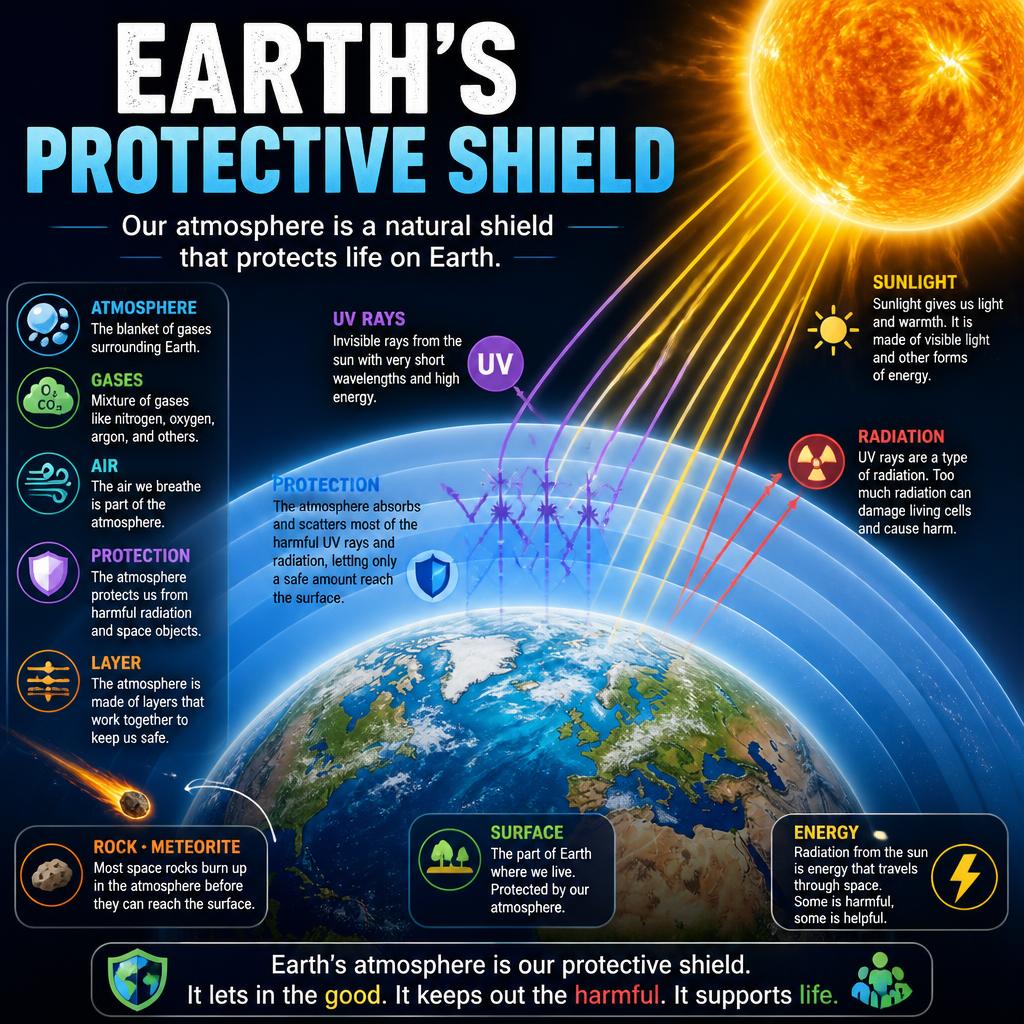
What do you need every second of the day but cannot grasp?
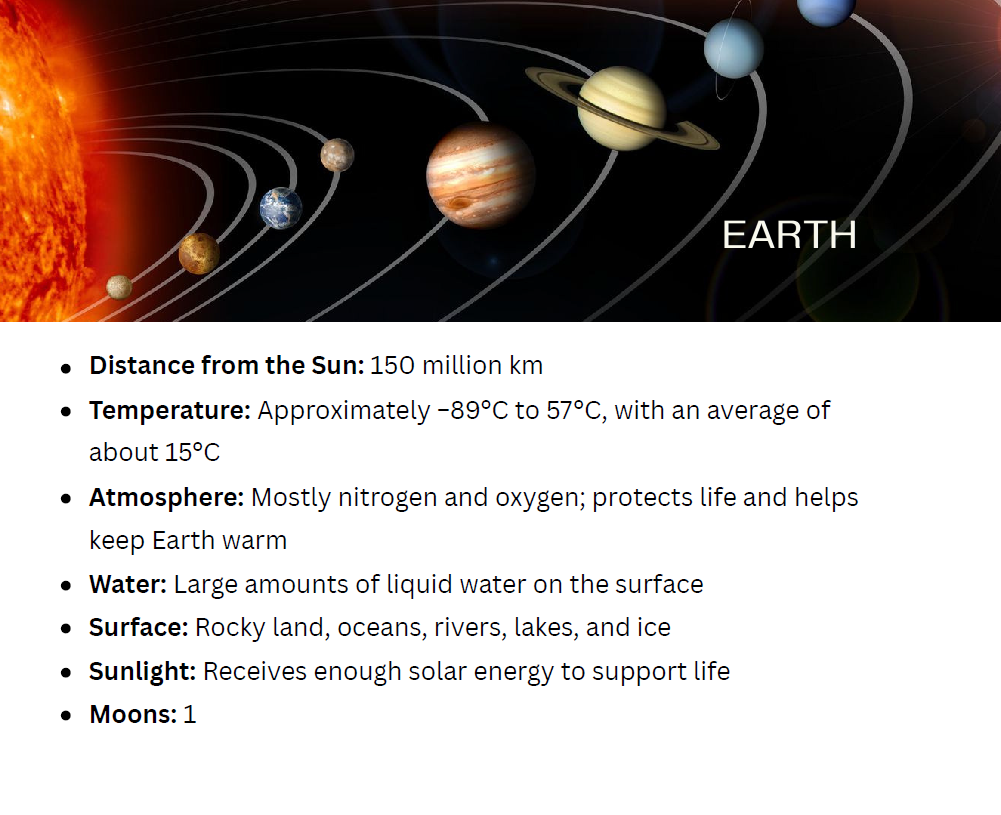
Use the Earth card and the suggested sources to find information about the gases in Earth’s atmosphere.
Earth's Atmosphere on NASA: https://spaceplace.nasa.gov/atmosphere/en/
All about Earth from NASA: https://science.nasa.gov/earth/facts/?utm_source=chatgpt.com
Now, use this spreadsheet to add the information you have found for each substance: https://docs.google.com/spreadsheets/d/1Tm2mPODJrb3vutgKa-STVT3SX5AMRPnMS9qV8GxoBWM/edit?usp=sharing
Useful vocabularygas · air · mixture · layer · surround Numbers & proportionspercentage · percent · amount · proportion · most · least · about · approximately |
Think and answer!
|
Useful language
|
Think further!Why do you think Earth needs an atmosphere for life? |
Updated on October 13, 2026
Exploring Earth: Science through English
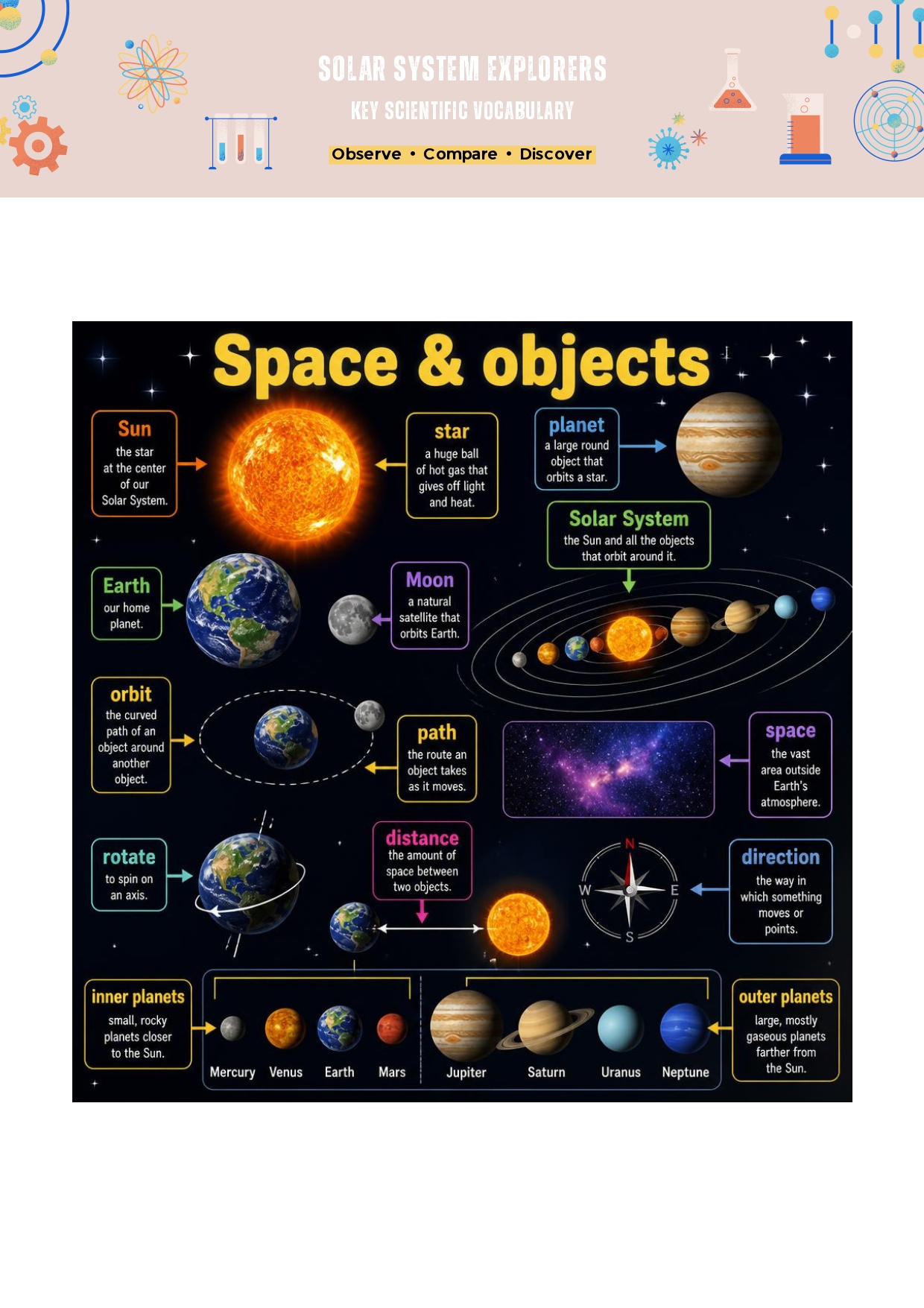
Let’s build our Solar System vocabulary! This poster illustrates key scientific words and their meanings to help us understand and talk about Earth, the Sun, the Moon and the planets.
Updated on October 5, 2026
Solar System Explorers
Here are some words and expressions that will help you explore the Solar System, Earth's position, the atmosphere and Earth's movements!
What can you find?
|
Position: near · far · between · around · inside · outside · centre · left · right Movement: move · travel · orbit · rotate · turn · pass · go around Size: big · small · larger · smaller · largest · smallest · similar |
| How are the planets different? |
|
| What do you notice about planetary orbits? |
|
Now, do the crossword to check how much you know!
Updated on September 29, 2026
Our European Living Environment Map
Follow the link to see the map!
https://padlet.com/myrtoner/our-european-living-environment-map-s0240w2ucknl6sqiwtvd
Updated on September 21, 2026
Something interesting about Thessaloniki: The Vardaris wind
Did you know that Thessaloniki has its own famous local wind? It is called Vardaris (Βαρδάρης).
Vardaris is a cold and strong wind that usually blows from the north or north-west. It moves through the Vardar–Axios River valley before 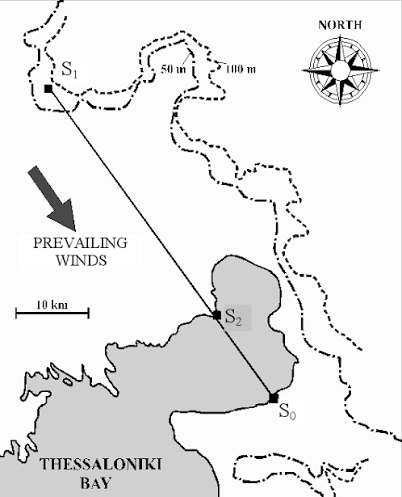 reaching Thessaloniki and the Thermaic Gulf. The mountains and the shape of the valley help guide the cold wind towards the city.
Vardaris is especially common during the cold months. When it blows, the temperature can feel much lower because the strong wind makes us lose heat from our bodies more quickly. Sometimes it can be very strong and create difficult weather conditions in the city and the surrounding areas.
The Vardaris is an important part of life in Thessaloniki. People who live in the city know that when the Vardaris starts blowing, cold, windy weather is on its way! It is one of the special features of our local environment.
Did you know?
The name Vardaris comes from the Vardar River, which is called Axios in Greece. The river flows through the Balkans before reaching the Thermaic Gulf.
Updated on October 7, 2026
Let’s introduce ourselves to our European partners!
It’s time to introduce ourselves to our European partners!
Before we share our profiles, think about who you are, where you live, what is your favourite element of nature and what makes your local environment special.
Use these sentences to help you!
|
My favourite element of nature
|
What can you choose? sea · beach · river · lake · mountain · hill · forest · park · garden · field · meadow · waterfall · island · coastline · trees · flowers · animals · birds Why do you like it? beautiful · peaceful · quiet · relaxing · interesting · exciting · colourful · amazing · special · green · natural · fun |
|
Something interesting
|
What can you choose?
|
|
My question |
|
https://padlet.com/myrtoner/hello-we-are-s023rzwmlh11r28m84ig
Updated on September 21, 2026
Words to Explore Our World!
| PLACES & AREAS
town · city · neighbourhood · region · country · local · area · place · location · countryside |
OUR ENVIRONMENT
environment · nature · green space · surroundings · landscape · coast |
| LANDSCAPE
sea · coastline · mountain · hill · lake · field · valley · plain · field · forest · wood · meadow · cliff · island · beach |
DESCRIBING PLACES
dry · wet · warm · cold · hot · cool · sunny · rainy · windy · green · quiet · busy · mountainous · flat · rural · urban |
| OUR SENSES
sound · see · hear · look · observe · notice · loud · quiet
|
HUMAN ENVIRONMENT building · house · school · road · street · bridge · park · playground · shop · harbour · farm · factory · traffic · transport
|
Now, do the quizzes to find out how much you know!
Ready, Set, Explore! Our Environment Word Hunt!