
Updated on November 2, 2026
Weather watchers: Greece meets France
What is the weather like today in Greece and France? Is it sunny, cloudy, rainy or windy? Are temperatures similar in different places, or can the weather change from one region to another?
Follow the links to explore weather in the two countries!
Weather in Greece (AI Overview)
Now, it’s time to become young weather scientists! Over the next 2–3 weeks, you will observe and measure the weather every day. You will record the temperature, cloud cover, wind, humidity and rainfall in our very own Weather Journal.
Updated on November 3, 2026
Let’s practise weather vocabulary
Now, log in to record your answers in the following quizzes!
Updated on October 29, 2026
Let’s practise weather vocabulary
Now, log in to record your answers in the following quizzes!
Updated on October 29, 2026
Let’s talk about weather!
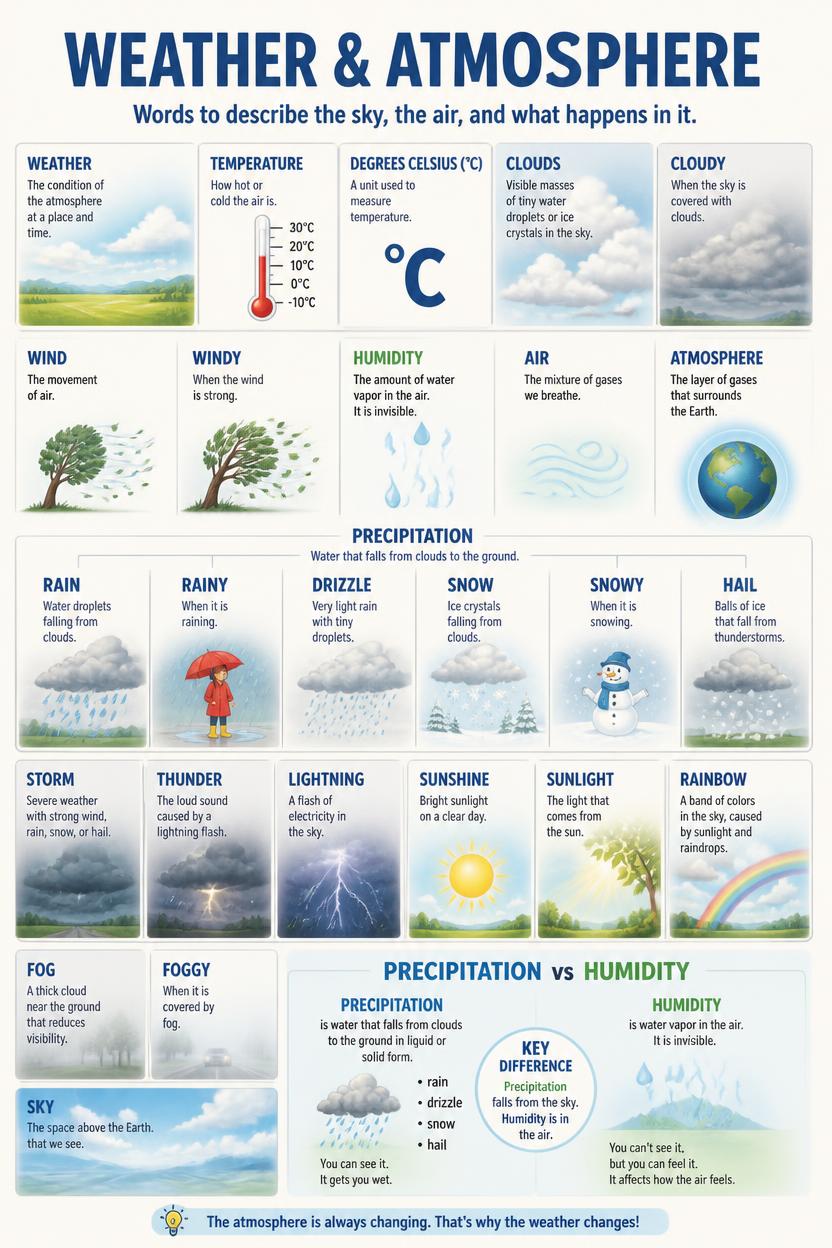
The following words and expressions will help you investigate and compare weather data!
| Temperature | degrees Celsius (°C), maximum ≠ minimum temperature, high ≠ low temperature, hot, warm, mild, cool, cold, freezing, temperature range | The temperature is 18°C. The maximum temperature is 22°C. It is cold today. The temperature ranges from 12°C to 20°C. |
| Wind | wind speed, wind direction, light ≠ strong wind, calm, breezy, windy, gust, gusty | It is windy today. The wind speed is 25 km/h. The wind is coming from the north. There are strong gusts of wind. |
| Humidity | relative humidity, high ≠ low humidity, humid ≠ dry, water vapour | The relative humidity is 70%. The air is humid. Humidity is high today. The air feels dry. |
| Precipitation | rain, rainfall, drizzle, showers, heavy ≠ light rain, snow, hail, chance of rain | There is a chance of rain. Light rain is expected. There will be heavy showers this afternoon. Rainfall is 10 mm. |
| Cloud cover | cloudy, clear, partly cloudy, overcast | The sky is clear. It is partly cloudy. There are dark clouds in the sky. The sky is overcast. |
Weather measurements are the data we record, such as temperature in °C, wind speed in km/h, relative humidity in % and rainfall in mm.
Talking about data
|
Comparing places
|
| Making observations and asking questions |
|
Updated on November 4, 2026
Infographic: Why Earth Can Support Life
Let’s bring our findings together and collaborate to create an infographic showing how the key conditions that support life on our planet work together!
Our class has undertaken the Energy from the Sun, The Atmosphere, Everything Is Connected!, and Our Scientific Conclusion blocks. Follow the link and use words and expressions from the table to contribute your ideas in the shared document.
Block 2 — Energy from the Sun
|
Build an explanation
|
Block 3 — The Atmosphere: Earth's Protective Layer
|
Build an explanation
|
Block 6 — Everything Is Connected!
|
Connect ideas
|
Block 4 — Our Scientific Conclusion
|
Draw a conclusion
|
Link to the infographic: https://canva.link/b8g234i2ueiswzm
https://docs.google.com/document/d/1ShSSVjNZ5yBnGh2Plc24c4hHN8xkrRBX3D1mudRTJ3I/edit?usp=sharing
Posted on October 18, 2026
Let’s talk about weather!
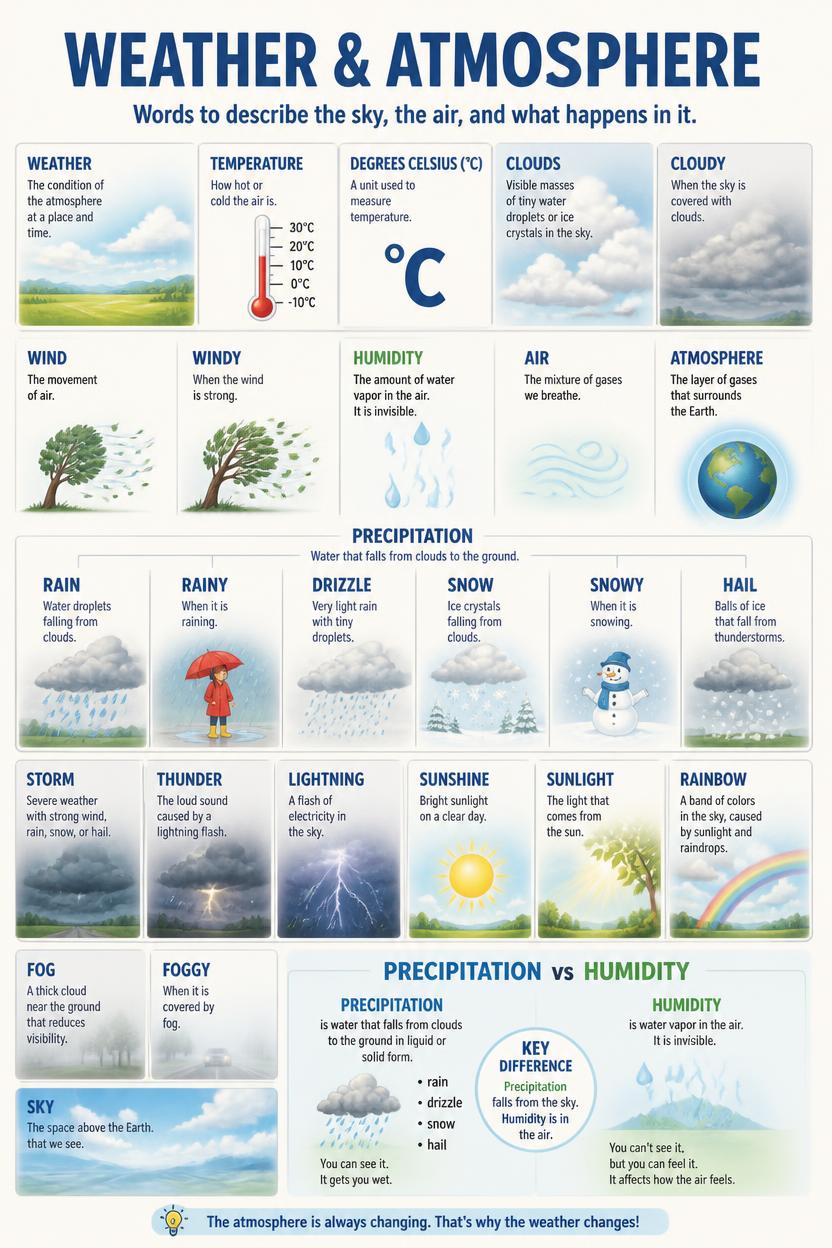
The following words and expressions will help you investigate and compare weather data!
| Temperature | degrees Celsius (°C), maximum ≠ minimum temperature, high ≠ low temperature, hot, warm, mild, cool, cold, freezing, temperature range | The temperature is 18°C. The maximum temperature is 22°C. It is cold today. The temperature ranges from 12°C to 20°C. |
| Wind | wind speed, wind direction, light ≠ strong wind, calm, breezy, windy, gust, gusty | It is windy today. The wind speed is 25 km/h. The wind is coming from the north. There are strong gusts of wind. |
| Humidity | relative humidity, high ≠ low humidity, humid ≠ dry, water vapour | The relative humidity is 70%. The air is humid. Humidity is high today. The air feels dry. |
| Precipitation | rain, rainfall, drizzle, showers, heavy ≠ light rain, snow, hail, chance of rain | There is a chance of rain. Light rain is expected. There will be heavy showers this afternoon. Rainfall is 10 mm. |
| Cloud cover | cloudy, clear, partly cloudy, overcast | The sky is clear. It is partly cloudy. There are dark clouds in the sky. The sky is overcast. |
Weather measurements are the data we record, such as temperature in °C, wind speed in km/h, relative humidity in % and rainfall in mm.
Talking about data
|
Comparing places
|
| Making observations and asking questions |
|
Posted on October 18, 2026
Weather watchers: Greece meets France
What is the weather like today in Greece and France? Is it sunny, cloudy, rainy or windy? Are temperatures similar in different places, or can the weather change from one region to another?
Follow the links to explore weather in the two countries!
Weather in Greece (AI Overview)
Now, it’s time to become young weather scientists! Over the next 2–3 weeks, you will observe and measure the weather every day. You will record the temperature, cloud cover, wind, humidity and rainfall in our very own Weather Journal.
Posted on October 15, 2026
Infographic: Why Earth Can Support Life
Let’s bring our findings together and collaborate to create an infographic showing how the key conditions that support life on our planet work together!
Our class has undertaken the Energy from the Sun, The Atmosphere, Everything Is Connected!, and Our Scientific Conclusion blocks. Follow the link and use words and expressions from the table to contribute your ideas in the shared document.
Block 2 — Energy from the Sun
|
Build an explanation
|
Block 3 — The Atmosphere: Earth's Protective Layer
|
Build an explanation
|
Block 6 — Everything Is Connected!
|
Connect ideas
|
Block 4 — Our Scientific Conclusion
|
Draw a conclusion
|
Link to the infographic: https://canva.link/b8g234i2ueiswzm